

San Diego Criminal Justice Memorial
Honorees
A memorial directory honoring deceased judges, prosecutors, and defense attorneys who advanced criminal justice in San Diego County.
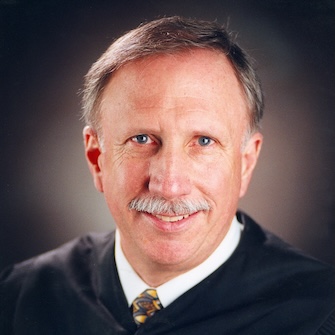
Hon. Michael D. Wellington
1945-2021
The Honorable Michael D. Wellington devoted four decades to the pursuit and administration of justice, leaving a legacy that continues to inspire today. Remembered for his intellectual excellence, judicial courage, and profound respect for the rule of law, Judge Wellington embodied the intersection of law and humanity. A distinguished appellate attorney, respected Superior Court judge, gifted teacher, and generous mentor, he was known as much for his thoughtful administration of justice as for his extraordinary command of the law. He left an indelible mark on the San Diego legal community and in California jurisprudence.
Judge Wellington worked as a door-to-door encyclopedia salesman to be able to pay for his own undergraduate education at San Diego State University. In 1971, he earned his law degree from the University of San Diego School of Law, beginning a legal career that would eventually take him from San Diego to the United States Supreme Court and back to serve on the local bench.
Following law school, Judge Wellington joined the California Department of Justice as a Deputy Attorney General, where he spent 18 years developing an exceptional reputation in criminal appellate advocacy, particularly in habeas corpus and capital litigation. When California adopted its determinate sentencing system in the late 1970s, Judge Wellington took the lead in writing the Attorney General’s first Determinate Sentencing Law Manual. His work provided prosecutors throughout California with an essential resource for navigating the state’s newly enacted sentencing laws.
In 1983, Judge Wellington argued the landmark case of Pulley v. Harris before the United States Supreme Court, defending California’s death penalty procedures against a constitutional challenge. The Court ruled 7–2 in favor of the position he advanced, establishing an important precedent concerning the constitutional requirements for reviewing capital sentences.
In 1989, Governor George Deukmejian appointed him to the San Diego Superior Court, where he served for the next two decades. He became one of the court’s most respected criminal jurists, frequently entrusted with cases involving exceptionally difficult legal questions, serious crimes, and intense public scrutiny. His fellow judicial colleagues twice elected him Supervising Criminal Judge, reflecting the confidence they placed in his judgment and leadership.
Among the significant cases over which he presided was the capital prosecution of Ivan and Veronica Gonzales for the torture and murder of four-year-old Genny Rojas, one of San Diego County’s most disturbing child abuse cases. The California Supreme Court subsequently affirmed the convictions and sentences. He also presided over People v. Davis, a fetal homicide prosecution that led to an important California Supreme Court decision clarifying the state’s homicide law. Facing a highly sensitive 19-count serial child molestation trial, Judge Wellington ruled that the NBC documentary series Crime and Punishment could capture the proceedings in his courtroom. Under national television cameras he thoughtfully balanced public institutional transparency with the strict psychological protection of traumatized child witnesses.
Judge Wellington understood that the responsibility of a judge was to apply the law faithfully, regardless of the attention a case might attract or the popularity of a decision. In 2007, he disqualified the San Diego City Attorney’s Office from a criminal prosecution after determining that the necessary ethical separation between its civil and criminal functions had been compromised. The following year, he presided over the politically sensitive perjury trial of a Chula Vista Councilmember, carefully evaluating the evidence and dismissing individual charges when he found them insufficiently supported. In 2011, he issued a significant ruling in In re Taylor, finding that blanket enforcement of sex offender residency restrictions in San Diego violated constitutional protections under the circumstances presented. The California Supreme Court subsequently upheld the restriction on blanket enforcement in 2015.
Countless attorneys considered Judge Wellington a role model. The Honorable Daniel Goldstein stated about Judge Wellington: “I had the privilege of appearing in Judge Wellington’s courtroom for a set of death penalty trials lasting 2 years. The trials were emotional and difficult. Judge Wellington presided over the cases with intelligence, care, and compassion. His rulings were clear and concise. His command over his courtroom had a tremendous influence on my career and the way I came to understand the criminal justice system.”
Upon Judge Wellington’s retirement, then-Presiding Judge Kenneth K. So praised his handling of difficult and complicated cases, his statewide judicial instruction, and the “invaluable leadership and mentorship” he provided to the bench.
Judge Wellington officially retired from active judicial service in late 2008 but immediately transitioned to the Assigned Judges Program to help his colleagues with significant court caseloads and continue his service to the legal community. His alma mater, the University of San Diego School of Law, recognized his distinguished career with its Distinguished Alumni Award in 2009.
Those who knew Judge Wellington also knew a man whose interests extended well beyond the law. An avid golfer and accomplished photographer, he filled his judicial chambers with his own photographs and personal memorabilia. He performed in one of San Diego’s favorite all-lawyer rock bands, “Law in Motion” where he played the rhythm guitar from 1980-1990. Despite the gravity of the cases he handled and the distinction he achieved, he remained grounded in a simple philosophy about work and life:
“Don’t be managing your life to try to position yourself for something in the future. Pick something that you enjoy doing that you think is meaningful to you and do it the very best you can.”
From a young man selling encyclopedias to pay his way through San Diego State, to an accomplished advocate before the United States Supreme Court, to a respected judge serving the community where his legal career began, Judge Wellington approached his work with unparalleled dedication and thoughtful reflection in his approach to justice and those he served.
Judge Wellington passed away on December 1, 2021, at the age of 77, followed in death by his beloved wife Sarah. He left behind far more than an impressive record of legal accomplishments. His influence can be found in the attorneys he trained, the judges he mentored, the law he helped shape, and the example he set for those who followed him into public service.
His induction into the San Diego Criminal Justice Memorial honors a life devoted to justice and a legacy that will continue to inspire those entrusted with its administration.