

San Diego Criminal Justice Memorial
Honorees
A memorial directory honoring deceased judges, prosecutors, and defense attorneys who advanced criminal justice in San Diego County.
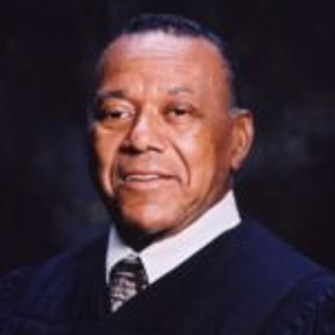
Hon. Earl B. Gilliam
1931-2001
Born in Clovis, New Mexico, Gilliam’s family moved to Oklahoma City during the depths of the Depression. In 1941, during the military buildup to World War II, his family brought him in the fifth grade to San Diego, where he spent the rest of his life near his family home on Imperial Avenue. The home was not far from his father’s business, which imported fresh water fish from Louisiana to sell to wholesalers, restaurants, and customers. He attended San Diego High School, where he was involved in gymnastics, football, basketball, and track. He would later open his private practice in the 2800 block of Imperial Avenue. Throughout his life, Gilliam would stroll that neighborhood greeting the many friends and residents. In 2005, the Post Office named its Imperial Avenue branch in his honor.
Earl Gilliam received his Bachelor of Arts degree from San Diego State College in 1953 and J.D. from Hastings College of Law in San Francisco in 1957. That same year he began his legal career as a deputy district attorney in the San Diego District Attorney Office. In 1961, Gilliam went into private practice. He handled many pro bono criminal defense cases from his office, which he described as one of the first “storefront” law firms.
He became a judge of the San Diego Municipal Court in 1963. In an interview, he recalled that his appointment was “quite a thing because there were only three black lawyers in the City. There was a question in those days whether white litigants who stood before a black judge would have confidence in his decisions. I like to think I dispelled that concern.”
In 1975 was elevated to the San Diego Superior Court. He served until 1980. He was appointed “the day after he turned 44.” He served as presiding judge for criminal cases.
In 1980, he was appointed to be a judge of the United States District Court, Southern District of California, by President Jimmy Carter. In 1993, he attained senior status. He found the federal court more “solemn” than the “exciting and interesting state courts.” In an 1983 interview he told Dicta that he “gets excited in the morning when he comes to work.” “He’s gregarious, committed to devoting significant energy to community service, and has long been digging into scholarly activities that take him regularly to local university campuses. The judge likes life.” (Dicta Nov. 1983).
Judge Gilliam presided over several noteworthy federal criminal cases, including complex white collar crimes such as the National Health Laboratories settlement of $110 million in fines for health care billing and the Telink kickback trial; Del Mar Mayor Nancy Hoover Hunter’s fraud and tax evasion trial, which was related to the Dominelli Ponzi scheme; the bad checking writing case of sportscaster “Fast Eddie”; and the controversial, acrimonious prosecution of a local criminal defense attorney who got too close to his client. He was the judge in the civil case that led to the landmark Daubert standard that allowed judges greater latitude in determining the admissibility of scientific evidence.
As a sentencing judge, he was known for his compassion, his dedication to trying to understand the individual in front of him, and his leniency for first-time offenders. He was respected for his ability to explain the sentence imposed to defendants and their families in a manner that kept them from feeling bitter toward the criminal justice system. Judge Judith Keep related that Judge Gilliam “made everyone who appeared before him feel the warmth of his soul and the breadth of his humanity.” (San Diego Lawyer, June 2001).
Judge Gilliam was a law professor at Western State College of Law, an instructor in urban and rural studies at the University of California at San Diego and a guest lecturer at the United States International University.
Judge Gilliam has been honored with many awards during his legal career, including Young Man of the Year, San Diego Chamber of Commerce (1965); Citizen of the Year for San Diego (1973 and 1994); Good Guy Award for San Diego (1974); Golden Man of the Year, Boy’s Club of San Diego (1981); Trial Judge of the Year, San Diego Trial Lawyers Association (1981); and the San Diego High School Wall of Honor (1994). He was named Legal Professional of the Year by the San Diego County Bar Association (1994). In 2003, the Earl B. Gilliam Bar Association erected a memorial plaque in the Hall of Justice.
Judge Gilliam’s community and civic activities were many. In 1982, the Association of Black Attorneys of San Diego County which was formed in 1976, formerly changed its name to the Earl B. Gilliam Bar Association in his honor. He was the first black American U.S. District judge for the Southern District of California as well as the first black American judge to serve as a San Diego County Superior Court judge. Today, the Earl B. Gilliam Bar Association represents the interests of over 300 African-American lawyers, judges, law professors and students as well as the African-American community in San Diego.
Judge Gilliam received the Wiley A. Branton Award from the National Bar Association in 1997. In 1998 he received the Judicial Pioneer Award from the California Association of Black Lawyers. He was also inducted into the National Bar Association Hall of Fame which honors lawyers who have been licensed to practice for forty years or more and have made a significant contribution to the cause of justice.