

San Diego Criminal Justice Memorial
Honorees
A memorial directory honoring deceased judges, prosecutors, and defense attorneys who advanced criminal justice in San Diego County.
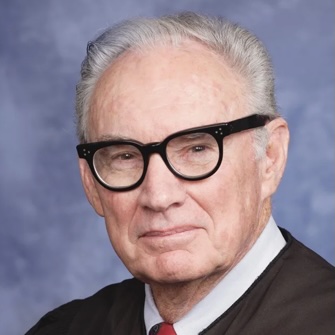
Hon. William B. Enright
1925-2020
On March 7, 2020, William B. Enright, one of the finest trial lawyers in San Diego history and perhaps its most influential trial judge, passed away at the age of 94. A gifted speaker with a sharp intellect and indomitable spirit, Judge Enright was committed to the highest ethical standards and utmost civility in the practice of law. He was a revered leader of San Diego’s trial bar and judiciary.
Judge Enright was born on July 12, 1925, in Queens, New York. When he was just 12 years-old, his father passed away. At age 17, after graduating from high school and with his mother’s permission, he enlisted in the United States Navy where he was assigned to the Marcus Island, a carrier escort, in the Pacific Theater of World War II. At the war’s end, in August 1945, he became part of the force that occupied Japan—“leaving as man,” he would say, 37 months after enlistment.
After his discharge, Judge Enright received his Bachelor’s Degree in philosophy from Dartmouth College and attended Loyola Law School in Los Angeles. During that time, he married the “love of his life,” Bette, with whom he shared 68 years of marriage. Together, they raised three exceptional children, one of whom is a distinguished San Diego Superior Court judge.
Judge Enright’s first job after graduation from law school was with the San Diego County District Attorney’s Office, starting in 1951. Three years later, he and several other county prosecutors started their own firm where Judge Enright spent much of the next two decades doing criminal defense work. He tried 223 cases to jury verdict over 22 years, and “built a reputation as one of the most formidable trial lawyers in San Diego and in the State of California,” according to his colleague on the federal bench, Senior District Judge Larry A. Burns. Attorneys would come from all over to watch the legendary trial lawyer in action. The “clocks stopped” when Judge Enright delivered his closing arguments, said former Chief Deputy District Attorney and Superior Court Judge Lou Boyle, who often watched the trial lawyer in action. Judge Enright’s prowess as a trial lawyer was recognized by his induction as a Fellow of the American College of Trial Lawyers and as a Diplomat of the American Board of Trial Advocates, two prestigious, invitation-only, national trial organizations.
Judge Enright’s commitment to trial advocacy, however, did not prevent him from participating in other aspects of legal and civic life. Indeed, he served as president of the San Diego County Bar Association in 1965, vice-president of the California State Bar Association in 1970, and president of Defenders, Inc. in 1972. He was also actively involved with the Rotary Club, United Crusade, Big Brothers, Little League, and Urban Coalition.
On June 13, 1972, at age 47, Judge Enright was nominated to the United States District Court for the Southern District of California. He was unanimously confirmed by the United States Senate on June 28, 1972. Judge Enright served for 47 years on the bench—28 years as an active and senior judge, and nearly 20 years in emeritus status. He presided over more than 300 criminal and civil jury trials, and was widely respected as a knowledgeable and fair judge who ran a no-nonsense court. Judge Enright also served on 17 different judicial governance committees at the circuit and national levels, including a stint on the Judicial Panel for Multi-District Litigation.
Judge Enright was among a small group of judges and lawyers who worked with Chief Justice Warren Burger of the United States Supreme Court to found the American Inns of Court in 1980, an organization devoted to fostering excellence in professionalism, ethics, civility, and legal skills. Today, there are more than 350 chartered American Inns of Court in 48 states and the District of Columbia. Judge Enright was a founding member of San Diego’s first Inn of Court, the Louis Welsh Inn (No. 9), and he assisted with the formation of many other Inns at both the state and national levels. He served as Trustee for the American Inns of Court Foundation upon its formation in 1985 until 1992, where he was one of ten Emeritus Trustees.
In 1987, the American Inns of Court Foundation awarded Judge Enright the Chairman’s Award for his “distinguished, exceptional and significant leadership to the American Inns of Court movement.” He was the only Californian to receive the award. Thereafter, he received the Professionalism Award for the U.S. Ninth Circuit from the American Inns of Court. In 1991, the William B. Enright American Inn of Court was chartered in San Diego, a recognition he regarded as the highest honor ever bestowed on him.
Through example and word, Judge Enright led the San Diego federal bench to better administer justice and serve its community. According to Judge Enright’s close friend and colleague on the federal bench, Senior District Judge Jeffrey T. Miller, Judge Enright was “our navigational star, the heart, soul and voice of the bench for decades, and the universal ambassador of our legal profession.” Until his death, Judge Enright remained an enthusiastic participant at the Court’s Monday Judges Meetings, a tradition he helped start given his firm belief that regularly “breaking bread” with colleagues and discussing the business of the Court fostered collegiality and camaraderie. Whistling down the hall, he was well-known for entering the judges’ conference room with a huge smile, and booming, “Well, well, well!” He infused every meeting with laughter, good cheer, and sage advice. He uplifted everyone, and always made his colleagues feel special. He was the Court’s leader to the very end.
A big believer in judicial independence, Judge Enright would tell his colleagues at the judges’ meetings, “Be fiercely independent. As judges, we have the power to do not what we want, but what is right and just under the law.” On maintaining civility in the courtroom, he advised: “Like water rising, you will get exactly that level of incivility that you tolerate.” On efficiency in trying cases and respect for jurors’ time, he informed his colleagues of the admonition he gave counsel before trial: “prune your own tree, for if you don’t, I will.” And on the majesty of trial by jury, he declared: “I believe in the adversary system. John Milton said, ‘Let truth and falsehood meet in open combat; you need not fear for truth.’ If you believe in democracy, as we all do, a jury is a microcosm of democracy.”
The tradition of the Monday Judges Meeting continues today and is a hallmark of the Court, which has developed a reputation as one of the most collegial and efficient courts among the nation’s 94 district courts. Prior to his passing, in a fitting tribute, his colleagues named the judges’ conference room atop the United States Courthouse in San Diego the William B. Enright Conference Room.
In 2008, Judge Enright founded the San Diego Criminal Justice Memorial. It is only fitting that he joins fellow distinguished colleagues as an inductee. On forming the Memorial, Judge Enright noted of the inductees: “They are part of the rich tradition and proud heritage of our community’s bench and bar. We acknowledge them for their contributions, dedication, and service. We do so to inspire present and future generations to honorable service in our adversary system. The current generation, and those to come, stand on the shoulders of the accomplishments of these fine men and women. Their dedicated participation in the justice system helped make our court system the envy of the world.” Inscribed on the granite Memorial plaque that lists the names of the inductees are Judge Enright’s words: “While we live, so will they.”
In tribute to Judge Enright, Judge Miller notes that “some people are born into this world with a sense of indebtedness for the blessing of being alive, with a sense of moral responsibility to serve both other people and the institutions we venerate. Bill Enright was such a man.” True to his words on the Memorial plaque, Judge Enright lives on through his family, colleagues, and friends, and through his significant and lasting contributions to the local, state, and national legal communities, and the San Diego community, at large. The embodiment of the Greatest Generation, Judge Enright possessed a kindness and chivalry and a classical devotion to service, honor, and duty—leaving an indelible mark. His peerless character, wisdom, and generosity will forever serve as an example and inspiration.